


Blog
Pedestrian Crash Statistics in California
Pedestrian deaths in California, Sacramento County and Placer County, with OTS rankings for Sacramento and Roseville and the crosswalk laws that apply.
- Published
- November 26, 2026
- Reading time
- 7 min read
- Author
- Gingery Hammer & Associates, LLP
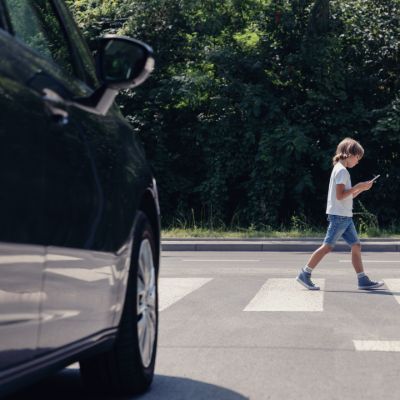
More than one in four people killed on California roads in 2024 was on foot. Nationwide, the share was less than one in five.
This page gathers the latest government numbers on pedestrian deaths and injuries for the U.S., California, Sacramento County, Placer County, the City of Sacramento and Roseville. It also explains California's crosswalk rules and the 2023 change in jaywalking enforcement, with the Vehicle Code sections cited.
Key numbers
- In 2024, 7,080 pedestrians were killed in U.S. traffic crashes, a 3.9% decrease from 7,367 in 2023. NHTSA estimates another 71,635 were injured.
- In 2024, California had 1,090 pedestrian deaths, the highest number of any state.
- In 2024, pedestrians were 28.1% of all traffic deaths in California, compared with 18.0% nationwide.
- In 2024, California's pedestrian death rate was 2.76 per 100,000 residents. The national rate was 2.08.
- In 2024, 76% of U.S. pedestrian deaths happened in the dark, and 73% happened at places that were not intersections.
- In 2024, 49 pedestrians were killed in Sacramento County, down from 86 in 2022. Placer County had 4.
- In 2023, the City of Sacramento ranked 4th of 15 California cities with more than 250,000 people for people killed or injured in pedestrian crashes. Roseville ranked 60th of 62 similar-sized cities (rank 1 is worst).
California pedestrian deaths over 10 years
California pedestrian deaths rose from 819 in 2015 to a peak of 1,213 in 2022, an increase of about 48% (calculated from NHTSA's counts). They have fallen in each year since, to 1,090 in 2024.
| Year | All traffic deaths | Pedestrian deaths |
|---|---|---|
| 2015 | 3,387 | 819 |
| 2016 | 3,837 | 933 |
| 2017 | 3,884 | 940 |
| 2018 | 3,798 | 978 |
| 2019 | 3,719 | 1,011 |
| 2020 | 3,980 | 1,013 |
| 2021 | 4,513 | 1,179 |
| 2022 | 4,539 | 1,213 |
| 2023 | 4,169 | 1,150 |
| 2024 | 3,876 | 1,090 |
The national count followed a similar path. U.S. pedestrian deaths were 5,494 in 2015 and peaked at 7,593 in 2022 before falling to 7,080 in 2024. California's 1,090 deaths were about 15% of the national total in 2024 (calculated from NHTSA's counts).
Sacramento County, Placer County, Sacramento and Roseville
NHTSA publishes pedestrian deaths by county. Sacramento County's count has swung widely from year to year. From 2020 to 2024, Placer County's count stayed in single digits in every year but 2022.
- City of Sacramento, 2023: 297 people killed or injured. Ranked 4th of 15 Group A cities (populations over 250,000).
- City of Sacramento, 2023: 20 pedestrians under 15 and 40 pedestrians 65 and older were killed or injured. Each ranked 4th of 15.
- Roseville, 2023: 23 people killed or injured. Ranked 60th of 62 Group B cities (populations 100,001 to 250,000).
- Sacramento County, 2023: 653 people killed or injured. Ranked 7th of 58 counties.
- Placer County, 2023: 73 people killed or injured. Ranked 52nd of 58 counties.
| Year | Sacramento County | Placer County |
|---|---|---|
| 2020 | 50 | 4 |
| 2021 | 77 | 5 |
| 2022 | 86 | 11 |
| 2023 | 69 | 3 |
| 2024 | 49 | 4 |
In 2024, Sacramento County's rate was 3.04 pedestrian deaths per 100,000 residents, higher than the statewide rate of 2.76. Placer County's rate was 0.92.
City of Sacramento: NHTSA lists every U.S. city of 500,000 or more people. In 2024, 18 of the 49 people killed in traffic crashes in the City of Sacramento were pedestrians (36.7%). The city's pedestrian death rate was 3.36 per 100,000 residents.
The California Office of Traffic Safety (OTS) also ranks cities and counties using state crash records. Its 2023 rankings, the latest published, count people killed or injured in crashes that involved a pedestrian:
When, where and who: what NHTSA's 2024 data shows
- Light: In 2024, 76% of pedestrian deaths happened in the dark, 20% in daylight, 2% at dusk and 2% at dawn.
- Time of day: The most deaths happened from 6 to 8:59 p.m. (24%), followed by 9 to 11:59 p.m. (23%). The fewest happened from 9 to 11:59 a.m. (4%).
- Weekends: On weekends, 28% of pedestrian deaths happened from 9 to 11:59 p.m.
- Location: 73% happened at places that were not intersections, 18% at intersections, and 9% at other places such as shoulders, sidewalks, medians and driveways.
- Urban roads: 84% of pedestrian deaths happened in urban areas.
- Hit-and-run: Nearly 1 in 4 pedestrians killed (24%) were struck by hit-and-run drivers.
- Alcohol: Alcohol involvement, for the driver, the pedestrian or both, was reported in 43% of fatal pedestrian crashes. An estimated 27% of fatal pedestrian crashes had a pedestrian killed with a BAC of .08 or higher, and an estimated 15% had a driver with a BAC of .08 or higher.
- Age and sex: 69% of pedestrians killed were male. The average age was 48. Pedestrians were 19% of people 65 and older killed in traffic crashes, and 17% of children 14 and younger killed.
NHTSA notes that alcohol involvement means alcohol was consumed before the crash. The presence of alcohol may or may not have been a contributing factor. In 2024, 90% of pedestrian deaths happened in crashes involving a single vehicle.
What California law says
California's pedestrian rules are in Chapter 5 of Division 11 of the Vehicle Code. Here they are in plain English, with the section numbers.
- Drivers yield in crosswalks. A driver must yield the right-of-way to a pedestrian crossing within any marked crosswalk, or within any unmarked crosswalk at an intersection (Vehicle Code § 21950(a)).
- Drivers slow down. A driver approaching a pedestrian in a marked or unmarked crosswalk must use all due care and reduce speed or take other action needed to keep that person safe (§ 21950(c)).
- Pedestrians use care too. A pedestrian may not suddenly leave a curb or other place of safety into the path of a vehicle so close it is an immediate hazard, and may not unnecessarily stop or delay traffic in a crosswalk (§ 21950(b)). That does not take away the driver's duty of due care (§ 21950(d)).
- What counts as a crosswalk. A crosswalk is either the extension of the sidewalk boundary lines across the road at an intersection where the roads meet at about right angles, or any part of the road marked for crossing with lines or other markings. There is no crosswalk where local authorities have posted signs saying no crossing (§ 275).
- No passing a stopped car. When a vehicle has stopped at a marked or unmarked crosswalk to let a pedestrian cross, a driver approaching from behind may not pass it (§ 21951).
- Outside a crosswalk. A pedestrian on the road anywhere other than a marked or unmarked crosswalk must yield to vehicles so near as to be an immediate hazard. The driver still must use due care for that pedestrian (§ 21954).
- Between signals. Between adjacent intersections controlled by traffic signals or police officers, pedestrians may not cross except in a crosswalk (§ 21955(a)).
The 2023 jaywalking change (AB 2147)
Assembly Bill 2147 (Statutes of 2022, Chapter 957) took effect on January 1, 2023.
The bill did not repeal the rule against crossing between signal-controlled intersections. Section 21955(a) still says pedestrians shall not cross there except in a crosswalk. What changed is enforcement. Under § 21955(b)(1), a peace officer "shall not stop a pedestrian for a violation of subdivision (a) unless a reasonably careful person would realize there is an immediate danger of a collision with a moving vehicle or other device moving exclusively by human power."
The same section says the change does not relieve a pedestrian of the duty to use due care for their own safety, and does not relieve a driver of the duty of due care for any pedestrian in the roadway (§ 21955(b)(2) and (3)). AB 2147 added the same stop limit to §§ 21950 and 21954, among other sections. It also requires the CHP to report to the Legislature on pedestrian crash data and the law's effect on safety by January 1, 2028.
What to do after a pedestrian crash
- Call 911 and get medical care. See a doctor even if the injuries seem minor.
- A driver involved in a crash that injures or kills someone must stop immediately (Vehicle Code § 20001). The driver must give their name, address, vehicle registration number and the owner's name and address, and must give reasonable help to anyone injured (§ 20003).
- If you can, photograph the scene, the crosswalk markings, signals and lighting, and the vehicle. Write down witness names and the officer's name.
- A driver involved in a crash with injury, death, or more than $1,000 in property damage to any one person must report it to the DMV within 10 days (§ 16000).
- Deadlines apply. A lawsuit for injury or death caused by someone else's wrongful act or neglect generally must be filed within two years (Code of Civil Procedure § 335.1). A claim against a city, county or other public agency for injury or death generally must be presented within six months (Government Code § 911.2).
How the numbers are counted
NHTSA counts a pedestrian as any person on foot, walking, running, jogging, hiking, sitting or lying down. People on skateboards, scooters, skates and wheelchairs are not counted as pedestrians in its fact sheet.
Deaths come from the Fatality Analysis Reporting System (FARS), a census of fatal crashes on public roads where someone dies within 30 days. The 2024 figures come from the Annual Report File and can change when it is finalized. For example, the 2023 count rose from 7,314 to 7,367 in the final file. Injury numbers are estimates from a national sample, not counts.
OTS rankings use crash data from SWITRS, California's statewide crash records system. A city ranking covers incorporated city streets and some state highways, but not freeways or state highways where the city has no jurisdiction. County rankings include all crashes within county borders. Rank 1 is the highest, or worst. OTS calls its rankings "only indicators of potential problems."
Data years: NHTSA's national, state, county and City of Sacramento figures are for 2024, the latest year published. The OTS rankings are for 2023, the latest year OTS has posted. The two sources count different things (NHTSA counts deaths; OTS counts people killed or injured), so their numbers should not be compared directly.
Frequently Asked Questions
How many pedestrians are killed in California each year?
In 2024, 1,090 pedestrians were killed in California traffic crashes, according to NHTSA. That was down from a peak of 1,213 in 2022, but higher than the 819 killed in 2015.
Does California have the most pedestrian deaths?
Yes: in 2024, California's 1,090 pedestrian deaths were the most of any state, followed by Texas (763) and Florida (668). By rate, New Mexico was highest at 4.22 per 100,000 residents. California's rate was 2.76.
When do most pedestrian deaths happen?
In 2024, 76% of U.S. pedestrian deaths happened in the dark. The most common time was 6 to 8:59 p.m. (24%), followed by 9 to 11:59 p.m. (23%).
How does Sacramento rank for pedestrian crashes?
In 2023, the City of Sacramento ranked 4th of 15 California cities with more than 250,000 people for people killed or injured in pedestrian crashes, according to OTS. Rank 1 is the worst. In 2024, NHTSA counted 18 pedestrian deaths in the city.
Is jaywalking legal in California now?
Not exactly: since January 1, 2023, an officer may not stop a pedestrian for crossing between signal-controlled intersections unless a reasonably careful person would realize there is an immediate danger of a collision. The rule itself is still in Vehicle Code § 21955(a).
Do drivers have to stop for pedestrians at an unmarked crosswalk?
Yes: Vehicle Code § 21950(a) requires drivers to yield to a pedestrian crossing within any marked crosswalk or any unmarked crosswalk at an intersection. Under § 275, an unmarked crosswalk is the extension of the sidewalk lines across the street at an intersection where the roads meet at about right angles, unless signs say no crossing.
How long do I have to file a pedestrian accident claim in California?
Usually two years from the injury, under Code of Civil Procedure § 335.1. If a city, county or other public agency may be responsible, a written claim generally must be presented within six months (Government Code § 911.2).
Sources
- NHTSA, Traffic Safety Facts: Pedestrians, 2024 Data (DOT HS 813 818): national deaths and injuries, light, time, location, alcohol, age, state and city tables
- NHTSA, State Traffic Safety Information (STSI) for California: statewide pedestrian deaths 2015-2024 and county pedestrian deaths 2020-2024
- California Office of Traffic Safety, OTS Crash Rankings Results, 2023: City of Sacramento
- California Office of Traffic Safety, OTS Crash Rankings Results, 2023: Roseville
- California Office of Traffic Safety, OTS Crash Rankings Results, 2023: Sacramento County
- California Office of Traffic Safety, OTS Crash Rankings Results, 2023: Placer County
- California Office of Traffic Safety, OTS Crash Rankings (population groups and method)
- California Vehicle Code § 21950 (drivers yield in marked and unmarked crosswalks; pedestrian and driver due care; limits on stops)
- California Vehicle Code § 275 (definition of a crosswalk, marked and unmarked)
- California Vehicle Code § 21951 (no passing a vehicle stopped at a crosswalk)
- California Vehicle Code § 21954 (pedestrians outside a crosswalk yield to vehicles that are an immediate hazard)
- California Vehicle Code § 21955 (crossing between signal-controlled intersections; stop limit since January 1, 2023)
- AB 2147 (Ting), Statutes of 2022, Chapter 957: bill text and Legislative Counsel's Digest
- California Vehicle Code § 20001 (duty to stop after a crash with injury or death)
- California Vehicle Code § 20003 (duty to give information and render aid)
- California Vehicle Code § 16000 (report to the DMV within 10 days)
- California Code of Civil Procedure § 335.1 (two-year deadline for injury and death claims)
- California Government Code § 911.2 (six months to present a claim against a public entity)
This article is general information, not legal advice. Every case depends on its own facts.
Related practice areas
- Roseville Pedestrian Accident Attorney
- Sacramento Pedestrian Injury Attorney
- Roseville Wrongful Death Attorney
Our offices: Personal injury attorney in Roseville · Personal injury attorney in Sacramento · Download the free California Personal Injury Guide